Cosmo Tech

Green Asset Management

Effectively balance sustainability, risk, financial and operational performance

Sustainability has become an exponentially growing opportunity for asset intensive industries.  Companies aim to cut
energy use, optimize asset lifecycles, improve maintenance to reduce waste, and prevent environmental incidents.

By leveraging AI Simulation and prioritizing asset management, decision-makers can balance trade-offs like efficiency, environmental impact, costs, and safety to boost sustainability performance.

Drive data-driven ESG compliance, empower
sustainable decision making

Implement a comprehensive sustainable framework with CO2 reporting for Scope 1, 2, and 3 emissions to boost ESG compliance, stakeholder trust, and sustainability efforts.

  • Adopt a holistic approach to sustainability in asset management and maintain a detailed view of emissions from energy use, waste, and water operations.
  • Evaluate ESG performance to show how your asset strategy supports long-term sustainability.
  • Ensure regulatory compliance and transparency with accurate, standardized reporting and decision-making.

Balance sustainability, operational and
financial trade-offs

Gain clarity on complex and siloed processes to develop optimal asset investment strategies for meeting sustainable, financial, operational performance and risk level targets over the short, medium and long term. 

  • Integrate sustainability into your economic model by considering CO2 emissions across asset lifecycles 
  • Implement strategies that will lead to long-term sustainability, while continuing to deliver returns on asset investment.
  • Increase the overall network sustainability and robustness in the face of uncertainty by quantifying the consequences of uncertainty.

Optimize energy use, advance net-zero objectives 

Capture opportunities to enhance energy consumption, reduce waste and lower greenhouse gas emissions, by significantly improving how assets are managed, from equipment to buildings.

  • Address performance uncertainty and challenges of renewable energy intermittency by modeling demand management and pricing impact 
  • Evaluate the profitability and feasibility of green energy investments, ensuring decisions are aligned with business goals, sustainability objectives and regulations
  • Find the optimal energy-mix layouts that align cost-effectiveness, operational efficiency and reduced carbon footprint.


Enhance asset reliability, drive sustainable operations 

Through optimal asset maintenance strategies and prompt issue resolution, our solution helps companies prioritize safety and risk mitigation for a secure, responsible and sustainable operational framework. 

  • Automatically identify bottlenecks, and prevent disruptions linked to costly breakdown and emergency repairs and assess the potential impact on safety and environmental risks
  • Simulate alternative maintenance policies and take corrective actions in a few minutes versus a few hours
  • Track, measure and optimize risk profiles across the asset network to maintain financial, environmental and employee safety within pre-defined boundaries.

Improve resource allocation, minimize waste

Leverage AI Simulation for superior resource optimization, ensuring assets are maintained and used at their peak efficiency and minimal waste. 

  • Manage resources and assets at various stages of their lifecycle and make decisions based on reliable data 
  • Extend asset lifespans and determine the optimal time for replacement through optimal asset management strategies
  • Optimize resource consumption and waste generation through advanced optimization.

Maximize green innovation, minimize
decision complexity 

The AI-Simulation platform empowers decision makers to modernize and innovate technology rather than replacing certain assets, driving sustainability and operational excellence.

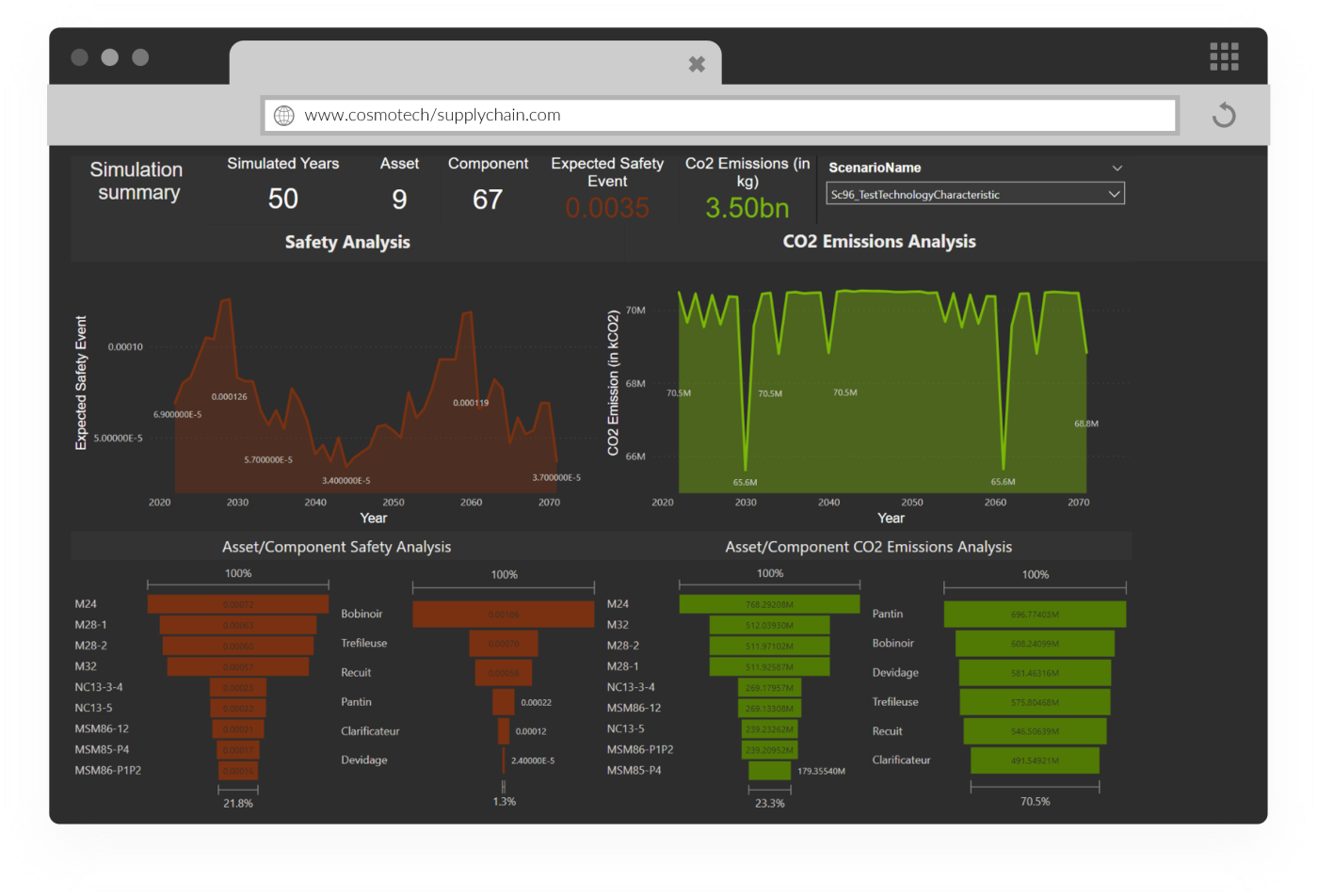
  • Simulate CO2 emissions from adopting cleaner technologies in your asset portfolio to assess their role in meeting sustainability and safety goals.
  • Evaluate the outcomes, costs, and risks of changes in processes, technology, or budget.
  • Consider factors like performance, demand, and regulations to address pricing challenges and refine your technology strategy.