The traditional formula that governed supply chain decision making no longer suffices. Reducing costs, optimizing inventory, improving service and quality, and driving growth remain fundamental priorities. But now, supply chains must also become more resilient, sustainable, and highly responsive to changing customer expectations. Exceptional execution and continuous improvement is vital due to the complexity involved in today’s supply chains.
Reinventing supply chains for the new world order clearly requires making more complex trade-offs and decision making than most operations teams have ever encountered, between a larger and more complex set of priorities. However, being able to make the right decision in a pool of thousands of possible options has become even more crucial.
The right supply chain trade-offs will, of course, vary by business. But in our experience with companies around the world and across industries, the most successful companies implement the following key capabilities to deal with the complexity of critical decision making:
Taking a holistic view to the whole system
Global enterprise organizations and their ecosystems are highly complex. Over the past twenty years, the number of connections — whether between people, machines, or both — has increased by a factor of 200,000. As variables multiply, trade-offs become more complex, leading to unpredictable downstream effects. Addressing one variable often creates new challenges in other areas of the supply chain.
Embracing uncertainty
Uncertainty is inherent in the business landscape. Global dynamics, technological advancements, and changing customer demands continually introduce uncertainties that shape operations. Embracing the unknown fosters agility, robust contingency plans, and resilience. Supply chain leaders who embrace uncertainty can navigate complexities and uncover new growth opportunities, staying ahead in a rapidly evolving marketplace.
More built-in flexibility and visibility
Increasing complexity and volatility necessitate a shift from fragmented and siloed visibility to end-to-end supply chain visibility and aligned decision-making. Enhanced situational awareness improves decision-making and risk management. It’s about more than efficient execution—it’s about responding to risks, adapting to customer needs, and making informed decisions on supply chain investments.
Digital Transformation
Digital transformation is essential for supply chain leaders, enabling data-driven insights over reliance on past experience or intuition. This shift may seem counterintuitive and require changing long-standing business practices. However, companies that master supply chain trade-offs will achieve strategic superiority and set new standards of operational excellence. They will capitalize on the opportunities presented by supply chain resets, investing in significant, bold initiatives and managing competing trade-offs throughout their transformation journey, ultimately achieving superior performance.
While a focus on operational efficiency will be maintained in the next three years, industrial organizations will shift their long-term attention to strategic decision making (46%) and risk planning (49%).*
Business leaders aiming to make optimal decisions for the future cannot rely solely on past events. They require simulated data, offering a view of the future, to make informed choices. This is why they turn to AI Simulation, anticipating a future that will differ from yesterday.
A technology that supports the complexity of an organization
Decision makers find in AI Simulation a technology that supports the complexity of their organizations and addresses greater uncertainty: every impact and cascading effect of a disruption or a decision can be simulated, including impacts that have not been experienced before.
Using AI-Simulation technology, supply chain managers can create unlimited predictive “what-if” simulations that demonstrate the impact of different decisions on operational efficiency and KPIs. They can evaluate the strength of their action plans, testing their robustness in the face of unexpected events and gaining valuable insights into how to implement their plans across the entire value chain.
Discover the best possible path out of thousands of possible scenarios
Advanced Simulation Twins further provide prescriptive “how-to” optimizations that help supply chain managers discover the course of action that best meets their needs. Users can choose among a range of KPIs (e.g. efficiency, cost, environmental needs), then use the simulation twin to discover the optimal action plan and implementation strategy for their business.
Today, there is an increasing understanding that climate change interacts both with supply chain resilience, economic performance and a changing regulatory environment.
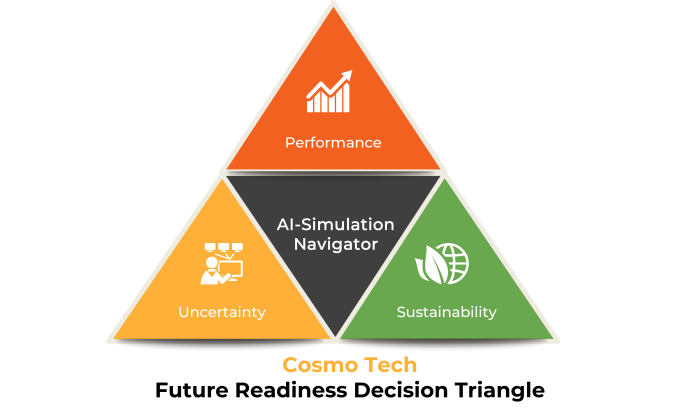
The Cosmo Tech Future-Ready Decision Triangle depicts a comprehensive approach to managing the full spectrum of environmental, social and economic impact on the entire value chain. This holistic model is designed to guide supply chain leaders through the complex interplay of these critical dimensions, ensuring that every decision contributes to a resilient, profitable and sustainable strategy.
Sustainable performance
The Cosmo Tech Future-Readiness Decision model allows companies to move from focusing on a single issue to a more systemic, multi-dimensional approach. The integration of sustainability metrics within the decision process enables companies to make accurate, proactive and long-term decisions, ensuring that the business decisions made today don’t compromise the resources of tomorrow.
Economic performance
In an era where market volatility and competitive pressure constantly threaten efficiency and profitability, the Cosmo Tech AI-Simulation technology makes it possible to balance competing constraints and the impact of decisions on them. It can improve economic performance and resilience at an unprecedented level, while securing a net zero CO2 emissions trajectory.
Risk and uncertainty management
Carbon footprint as well as economic objectives are always associated with a certain level of uncertainty. What would be the impact on delivery, profit and CO2 emissions if this transport route is disrupted? How can I mitigate the risk?
These are examples of questions and choices for which AI-Simulation technology helps users find the best answers.
Decision impact visibility and generating all possible future scenarios is now an imperative for critical decision making. We strongly believe that having easy access to AI-simulated data that provides reliable visibility into the future will increasingly play a central role in navigating risks, accelerating decisions, and optimizing choices at each stage of supply chain transformation.


